The endpoint is not the whole story
Most continuous controls are functions of position. Put a filter cutoff at the same value and, apart from the filter’s short settling time, it describes the same state. Afterimage was designed around a different possibility: the sound may depend on how the musician arrived.
A one-dimensional slider cannot achieve this merely by remembering motion. If it travels from the centre to the right and exactly retraces the same line, any reversible transport along that line is undone. A second coordinate is required. Afterimage takes that coordinate from the music itself: a smoothed amplitude envelope. The slider supplies deliberate gesture; the phrase supplies changing context.
The result resembles hysteresis in the broad sense that history matters, but the implementation is more specific. It accumulates orientation through a non-commuting sequence of rotations. There is no random walk. If the envelope remains constant and a gesture is precisely reversed, the transformation reverses too.
Where Afterimage lives
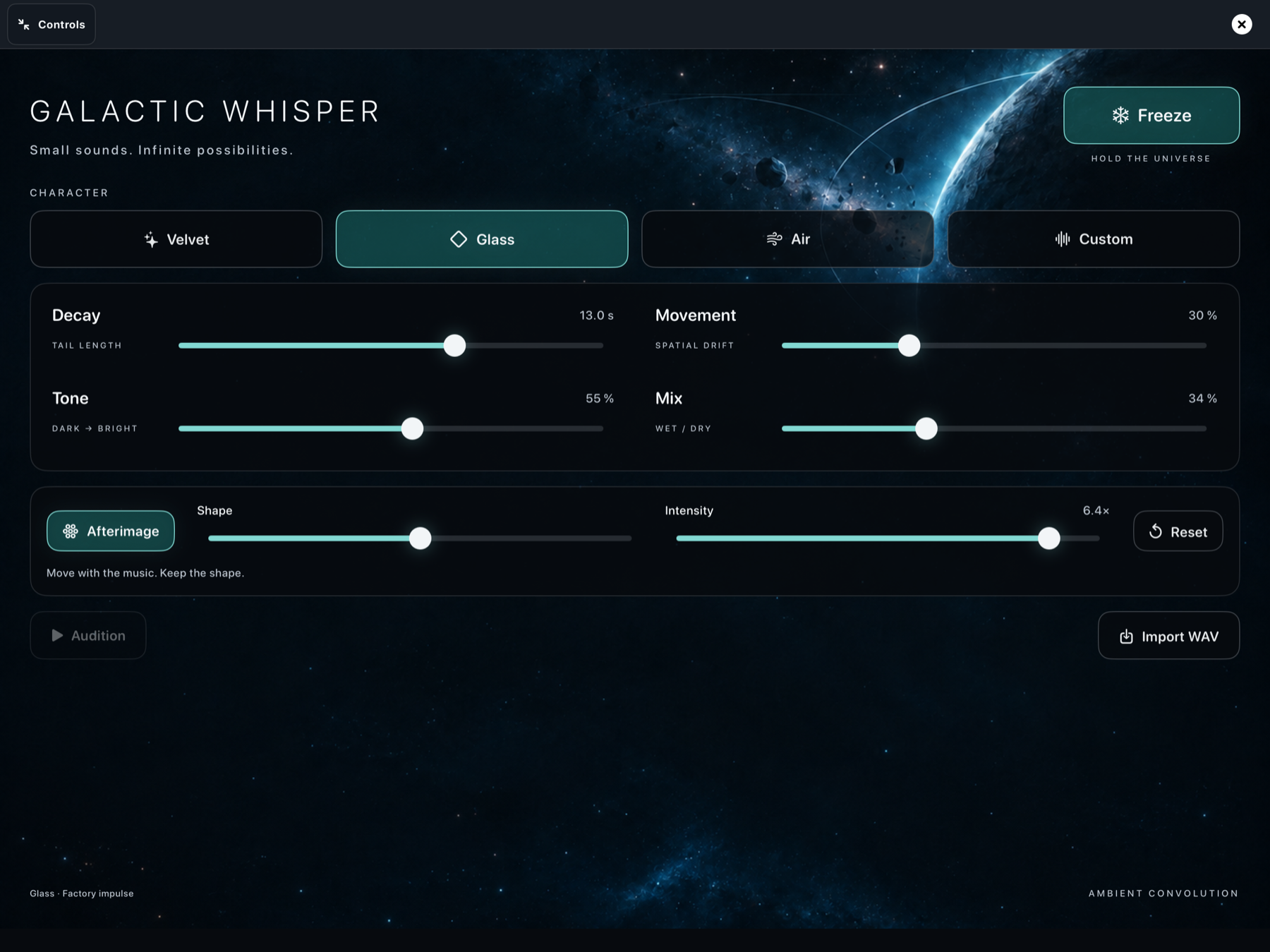
Galactic Whisper begins with a short prepared impulse response. The convolved signal excites an eight-line feedback delay network, whose unequal delay lengths spread energy into a dense ambient tail. Tone controls damping; Movement applies small fractional-delay motion; Decay determines feedback attenuation; Freeze approaches a lossless held network; Mix combines the wet result with the untouched source.
The fixed feedback mixer is Householder-like. For an eight-component delay vector v, each scattered component is
This transformation is orthogonal: before damping and other time-varying operations, it preserves the vector’s Euclidean norm. Afterimage does not replace that mixer. It rotates two selected triples immediately before the ordinary feedback stage continues.
A connection the musician can touch
Let x ∈ [0,1] be the Shape position and p the peak amplitude observed at the input. The peak follows a 12 ms attack and a 180 ms release. It is compressed into a bounded envelope coordinate
The envelope selects an axis in the first two dimensions of rotation space:
For a slider increment Δx, Afterimage constructs a unit quaternion
h = 2πgΔx,
and updates its retained orientation by quaternion multiplication and normalisation:
Here q and −q describe the same three-dimensional rotation. The implementation therefore chooses the nearer quaternion sign while smoothing audible changes, preventing a representation change from becoming a sudden sonic leap.
In continuous notation, the design is motivated by the connection
where A and B are non-commuting generators of rotation. Because the direction of the connection changes with e, transport around a loop in the (x,e) plane need not return U to its initial orientation. For a small loop, the surviving term is governed by the curvature of the connection and, for composed rotations, by the commutator [A,B] = AB − BA.
This is the useful idea behind the word holonomy: a state can return to the same visible coordinates while its transported orientation records the route. Afterimage borrows that geometric structure as a control law. It does not claim the reverb is a quantum system or that its rotation is a measurement of physical space.
Rotating relationships, not notes
The quaternion does not directly pitch-shift, filter, or pan the input. It rotates the values in delay-line groups (0,2,4) and (1,5,3). The remaining two lines continue unchanged. This alters how existing late energy is redistributed before it re-enters the feedback network.
That distinction explains the quality of the effect. Afterimage changes relationships among resonances rather than applying a large surface-level modulation. Piano material may acquire a hollow or bell-like extension; drums may reveal a different body in the decay; an unusual imported impulse can develop a persistent spatial colour. These are listening descriptions, not guaranteed outputs.
When Shape stops, Δx = 0, equation (4) becomes the identity step and the stored orientation holds. Reset requests the home quaternion (1,0,0,0) and returns Shape to centre. It does not discard the sounding tail. Turning Afterimage off smoothly returns the original scattering behaviour while keeping the discovered orientation available for comparison.
“The sound remembers the journey, while the control is free to look as though it came home.”
SORBUS WORKBENCH NOTE, 2026
More geometry, not merely more volume
The first playable version was deliberately subtle. Intensity was added to expose more of its range without turning it into a gain control. For a normalised Intensity value i ∈ [0,1], gesture sensitivity is
The display therefore spans 1× to 8×. The quadratic curve leaves more room near the original response and accelerates exploration at the top. Intensity by itself never changes the stored orientation; only Shape movement produces increments.
Intensity also moves the wet balance toward the geometry-affected late field. At its minimum, Galactic Whisper combines 0.45 parts early convolution with 1.40 parts tail. At maximum it reaches 0 early and 1.85 tail. The coefficient sum remains 1.85. Feedback gain, dry audio and excitation are unchanged. Equal coefficients do not imply equal perceived loudness, so output is softly bounded rather than advertised as loudness-invariant.
The mathematics must finish before the next buffer
An elegant control law is useless in an instrument if it steals time from the audio callback. The render thread performs fixed-size arithmetic only: envelope tracking, trigonometric evaluation for an actual gesture, quaternion multiplication, normalisation, two three-vector rotations and linear smoothing. It takes no locks, allocates no memory, opens no files and waits for no other thread.
Control and audio exchange the saved orientation through fixed three-slot single-producer/single-consumer mailboxes. The host can capture a coherent quaternion while rendering continues; the audio thread can adopt a requested Reset or restored patch at a callback boundary. Delay buffers and envelope history remain temporary performance state. The quaternion and parameters are patch state and survive save/reopen and audio-route rebuilding.
At 48 kHz, the envelope constants correspond to approximately 12 ms attack and 180 ms release, while orientation and enable changes are smoothed over approximately 25 ms. These times are part of the instrument: they keep the geometry responsive to phrase shape while avoiding zippering and abrupt scattering changes.
What has actually been shown
Automated tests establish the narrow claims the implementation depends on. A closed Shape gesture made across different envelope levels retains a non-home unit quaternion. The same out-and-back gesture at a constant envelope returns close to home. A stationary control does not drift. Results are independent of audio callback size, remain finite across 44.1, 48 and 96 kHz, and preserve exact dry audio at Mix zero and bypass.
Patch tests show that the stored orientation survives project round trips, while malformed or unsupported future states are rejected before partial mutation. Older Galactic Whisper documents reopen with Afterimage off and home, retaining their previous sound. Freeze prevents new input from steering or exciting the held tail, while Shape can still rotate the energy already present.
A native callback harness measured a 0.101 ms 95th-percentile render time and a 0.186 ms observed maximum for 128 frames at 48 kHz on the development Mac. Those measurements show bounded implementation behaviour in that harness. They are not proof of every iPad deadline, perceptual novelty, or musical superiority.
The remaining test is the one that matters artistically: whether a musician can move Shape, hear a resonant state worth keeping, and later recognise that state as part of the instrument rather than as an explanation imposed upon it.
A small opening into a larger space
Afterimage turns a conventional control into a conversation between hand and phrase. The slider proposes motion. The music chooses the axis. Quaternion multiplication retains their joint history. The feedback network makes that invisible orientation audible as a changed pattern of late resonance.
The mathematics matters because it enables a behaviour, not because difficult language makes the effect more valuable. At constant musical energy, going out and back returns home. Across a changing phrase, the same gesture may leave an afterimage. The musician can keep it, intensify it, compare it with the original or reset it.
That is the experiment: a reverb whose memory is neither an automation lane nor a captured tail, but a compact geometric consequence of having played with it.
END OF PAPER / LISTENING CONTINUES
Foundations and prior art
- M. R. Schroeder, “Natural Sounding Artificial Reverberation,” Journal of the Audio Engineering Society, 10(3), 219–223, 1962. AES record ↗
- K. Shoemake, “Animating Rotation with Quaternion Curves,” SIGGRAPH Computer Graphics, 19(3), 245–254, 1985. DOI ↗
- S. J. Schlecht and E. A. P. Habets, “Time-varying feedback matrices in feedback delay networks and their application in artificial reverberation,” JASA, 138(3), 1389–1398, 2015. PubMed ↗
- S. J. Schlecht, “FDNTB: The Feedback Delay Network Toolbox,” Proceedings of DAFx-20in21, 2020/21. Paper ↗
- S. Sugawa et al., “Wilson loop and Wilczek–Zee phase from a non-Abelian gauge field,” npj Quantum Information 7, 144, 2021. Open paper ↗
Implementation details and measurements are drawn from Sorbus source, tests, decision records and verification evidence dated 30 September 2026. The literature supports the mathematical and signal-processing context; it does not endorse Sorbus or establish Afterimage’s novelty.